How much does small tattoo removal cost?
Small tattoo removal typically costs $75-$300 per session in the US. Because providers often estimate 6 to 15 sessions, the total may range from about $450 to $4,500 before package discounts or additional fees.
For example, eight sessions at $150 each would cost $1,200. Ten sessions at $250 each would total $2,500. These figures are budgeting examples, not fixed quotes. Ink characteristics, laser technology, provider type, and geographic location can all affect the final price.
Some studios charge a minimum session fee. As a result, a tiny design may cost nearly as much per appointment as a somewhat larger tattoo in the same pricing category. Prices vary widely, so confirm the all-in package price at a consultation, including fees and the cost of any sessions beyond the initial estimate.
What counts as an extra-small or small tattoo?
Definitions differ between tattoo removal studios and clinics. An extra-small tattoo may be described as quarter-sized, under 1 square inch, or approximately 1 inch across. A small tattoo may cover roughly 1-4 square inches, although some providers use broader categories.
Ask how the clinic calculates size. One provider may classify a 1-inch tattoo by its widest dimension, while another measures the full inked area in square inches. Request a written consultation quote showing the size category, cost per session, estimated number of sessions, and package total. Results vary; discuss expectations at a consultation with a licensed provider.
Small tattoo removal cost by number of sessions
Estimated totals for 6, 8, and 10 sessions
Providers commonly quote 6 to 15 sessions for laser tattoo removal. The table below applies low, midpoint, and high per-session prices to several possible session counts.
| Number of sessions | At $75 per session | At $187.50 per session | At $300 per session |
|---|---|---|---|
| 6 | $450 | $1,125 | $1,800 |
| 8 | $600 | $1,500 | $2,400 |
| 10 | $750 | $1,875 | $3,000 |
| 12 | $900 | $2,250 | $3,600 |
| 15 | $1,125 | $2,812.50 | $4,500 |
For example, a clinic quoting eight visits at $187.50 each is estimating a total of $1,500. If another provider charges $300 per visit but quotes six sessions, its estimated total is $1,800. Comparing only the session price would miss the $300 difference between the complete estimates.
These calculations assume that every appointment has the same price. They do not include consultation charges, taxes, financing costs, or package discounts.
Estimated totals for 12 and 15 sessions
A longer quote changes the budget substantially. Twelve sessions cost $900-$3,600 at the stated price range, while 15 sessions cost $1,125-$4,500.
Ask whether a fixed package includes the full quoted number of visits. A package advertised at $2,400 for 12 sessions has an effective rate of $200 per session. However, confirm what happens if the provider recommends appointments beyond those 12. An additional-session rate of $250 would add $750 for three more visits.
The quoted number of sessions is an estimate, not a guarantee. Ink color, density, layering, tattoo age, and the provider’s assessment can influence the estimate. Results vary; discuss expectations at a consultation with a licensed provider.
Why a minimum session fee matters for tiny tattoos
Many clinics apply a minimum session fee regardless of whether a tattoo is quarter-sized or covers several square inches. If the minimum is $150, both a tiny symbol and a larger tattoo within the clinic’s small category might cost $150 per appointment.
Over eight sessions, that minimum creates a $1,200 budget even if pricing by square inch would otherwise be lower. Ask the provider to explain its size categories, minimum fee, package terms, and additional-session pricing in writing. Prices vary widely, so confirm the all-in package price at a consultation before comparing offers.
What determines the price of removing a small tattoo?
Factors that can change the cost per session
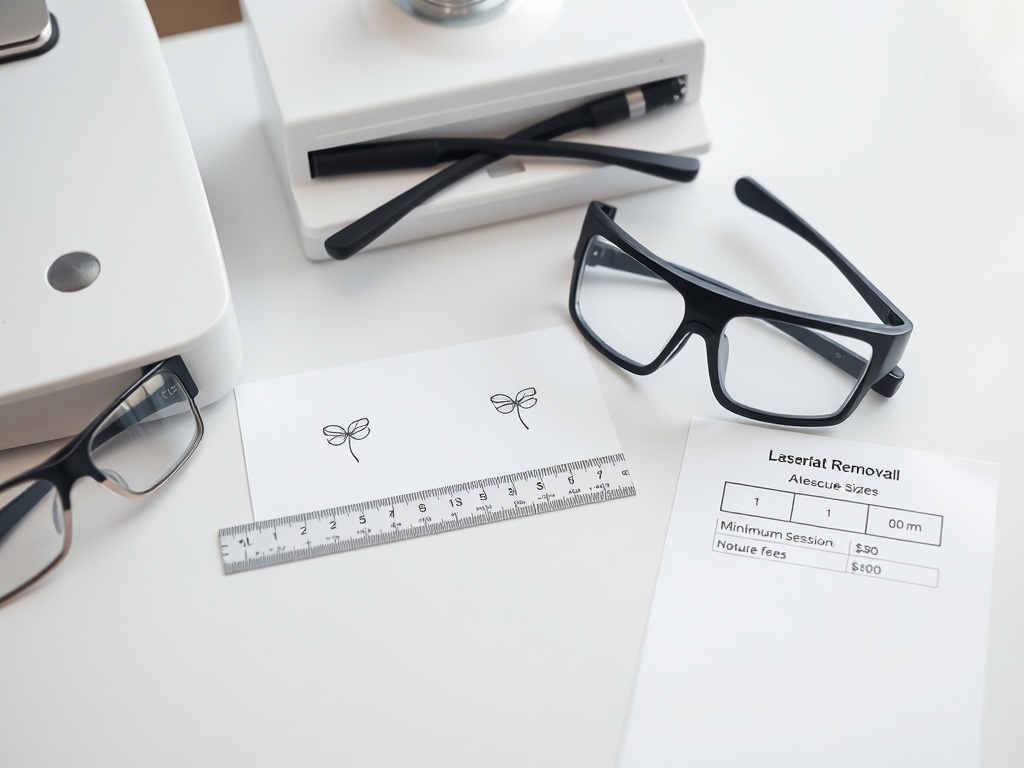
Providers may price laser tattoo removal by size category, measured square inches, or a minimum session fee. A quarter-sized tattoo and a 1-inch tattoo could therefore receive the same $150 minimum charge, even if their exact inked areas differ.
Geographic location also matters. Clinics in higher-cost cities may charge more than providers in smaller markets. Pricing can also vary among specialist tattoo removal studios, med spas, dermatology practices, and plastic surgery offices.
Equipment affects the quote as well. A clinic using a picosecond laser may set a different rate from one using a Q-switched laser or Q-switched Nd:YAG laser. The laser model, available wavelengths, equipment costs, and provider pricing policy can all influence the cost per session. No laser type should be assumed to guarantee fewer appointments or a particular outcome.
Ask for a written price showing:
- Measured tattoo size or size category
- Minimum session fee
- Cost per appointment
- Laser model and available wavelengths
- Consultation charges, taxes, and other fees
- Package price and additional-session rate
Factors that may change the session estimate
The session price is only one part of the total. Providers also estimate how many appointments to include, often quoting 6 to 15 sessions for budgeting purposes.
Ink color may influence the estimate because clinics evaluate which laser wavelengths they expect to use. Ink density is another consideration. A lightly inked design may receive a different estimate from a densely filled tattoo of the same size.
Tattoo age, placement, and layered ink can also affect the provider’s quote. For example, two 1-inch tattoos might both cost $175 per visit, but one may be quoted at eight sessions and the other at 12. Their estimated totals would be $1,400 and $2,100 respectively.
These are provider estimates, not guarantees. Results vary; discuss expectations at a consultation with a licensed provider.
Professional, amateur, and cover-up tattoos
Professional tattoos often contain consistent, concentrated ink across outlines, shading, and filled areas. Amateur tattoos may have less uniform ink depth or density. Those differences can lead a clinic to quote different session counts even when both tattoos occupy the same number of square inches.
Cover-up tattoos commonly contain multiple ink layers, including the original design and newer pigment placed over it. A provider may account for that layering by recommending a larger package or presenting a wider estimated session range.
Request an assessment based on the actual tattoo rather than relying solely on an online size chart. Prices vary widely, so confirm the all-in package price at a consultation, including package limits, expiration terms, and charges for appointments beyond the original estimate.
Pay per session, tattoo removal packages, or financing
Pay-per-session versus fixed package pricing

| Payment option | Main advantage | What to confirm |
|---|---|---|
| Pay per session | Lower upfront commitment and flexibility to change providers | Session price, minimum fee, and whether rates can increase |
| Fixed package | Potentially lower effective cost per visit | Number of included sessions, expiration date, and refund policy |
| Unlimited package | More predictable headline price | Eligibility, exclusions, scheduling limits, and additional charges |
| Financing | Spreads payments over time | Interest, fees, repayment term, and total financed cost |
Pay-per-session pricing can suit someone who prefers flexibility. At $175 per appointment, six visits cost $1,050 and 10 cost $1,750. However, the provider may change prices, and every visit may remain subject to a minimum session fee.
A fixed tattoo removal package requires a larger commitment but may reduce the effective per-visit cost. For example, an eight-session package priced at $1,200 works out to $150 per session, compared with $1,400 when paying $175 individually. Ask whether unused sessions are refundable or transferable and what additional appointments cost.
How unlimited-session packages work
“Unlimited” does not always mean unrestricted appointments with no conditions. A package may apply only to one specific tattoo, require appointments within a defined period, or exclude certain tattoo sizes, ink characteristics, and services.
Before paying, verify:
- Which tattoo and size category qualify
- Whether the package has an expiration date
- How appointments are scheduled
- Whether consultation fees, taxes, or deposits are separate
- Whether missed appointments affect eligibility
- What happens if the studio closes or you relocate
- Whether any additional-session fee can apply
Request the full terms in writing. Results vary; discuss expectations at a consultation with a licensed provider.
Payment plans and financing terms
A monthly payment is not the total purchase price. A $100 monthly payment for 24 months equals $2,400 before any deposit, interest, or financing fees. By comparison, the same package might have a $2,000 cash price.
Check the annual percentage rate, repayment length, origination fees, late charges, deposit, and total amount payable. Also ask whether financing covers additional sessions beyond the original estimate.
Prices vary widely. Compare the pay-per-session total, cash package price, and financed total using the same estimated number of sessions, then confirm the all-in package price at a consultation with a licensed provider.
Picosecond versus Q-switched laser pricing
Picosecond laser costs
Clinics offering picosecond laser tattoo removal may price small tattoos anywhere within or above the typical $75-$300 per-session range. The rate can reflect equipment costs, the clinic’s local market position, provider qualifications, and minimum session fees.
A higher appointment price does not automatically mean a lower total. For example, eight sessions at $275 would cost $2,200, while 10 sessions at $175 would cost $1,750. Session estimates are not guarantees, and laser technology alone does not determine value.
Q-switched and Q-switched Nd:YAG laser costs
Q-switched laser pricing may be lower, similar, or higher than picosecond pricing, depending on the provider. Ask for the exact laser model rather than relying on a broad technology label.
A Q-switched Nd:YAG laser may offer multiple wavelength options, and the clinic may consider the tattoo’s ink colors when preparing its quote. Available wavelengths, equipment, provider experience, geographic location, and pricing policies can all affect the advertised rate.
Do not assume that a specific laser model guarantees fewer sessions, better results, or complete removal. Results vary; discuss expectations at a consultation with a licensed provider.
How to compare different laser quotes
Compare each written estimate using the same criteria:
- Cost per session and minimum session fee
- Estimated number of sessions
- Total cash or package price
- Included visits and package expiration date
- Additional-session pricing
- Consultation fees, taxes, and deposits
- Laser model and available wavelengths
- Provider licensing and relevant experience
- Financing charges and total financed cost
A $150 session fee may look attractive, but a 12-session estimate totals $1,800. A competing eight-session package at $200 per visit totals $1,600 before fees. Neither estimate guarantees the final session count or outcome.
Prices vary widely, so compare the complete quote rather than choosing solely by the advertised laser type. Confirm the all-in package price at a consultation with a licensed provider.
How to compare clinics and get an all-in quote
Checklist for evaluating a tattoo removal clinic
Compare specialist tattoo removal studios, med spas, dermatology practices, and plastic surgery offices using the same criteria. Geographic location and provider type can significantly affect pricing, so a higher quote does not automatically represent better value.
Look for:
- A licensed provider whose credentials can be verified
- Disclosure of the exact laser model and available wavelengths
- Experience pricing tattoos with similar size, ink colors, density, and layering
- A written estimate showing the cost per session and expected session range
- Clear package, cancellation, and financing terms
- Realistic discussion of possible outcomes without guarantees
The consultation should explain how the tattoo was measured and why a particular number of sessions was estimated. Results vary; discuss expectations at a consultation with a licensed provider.
Costs and restrictions to confirm before paying
Request an itemized quote that separates the advertised price from possible additional charges. Confirm:
- Consultation fees and deposits
- Taxes and minimum session fees
- Number of visits included
- Package expiration date
- Rescheduling and cancellation charges
- Refund or transfer restrictions
- Additional-session pricing
- Financing interest, fees, and total amount payable
For example, a $1,200 package may include eight sessions, while three additional visits at $200 each would raise the estimated total to $1,800. A monthly payment can also look inexpensive while carrying a higher financed total.
Ask whether the quoted price applies only to one tattoo and whether changes in the recommended session count affect package terms.
Questions to ask when two quotes look different
Providers may classify the same tattoo differently. One clinic might label a 1-inch tattoo extra-small, while another calculates its full inked area and places it in a small category.
Ask each provider:
- How many square inches did you measure?
- What size category and minimum fee apply?
- Why did you estimate this number of sessions?
- How many visits does the package include?
- What does each additional session cost?
- Which laser model and wavelengths would be used?
- Are consultation fees, taxes, and deposits included?
- Why does your estimate differ from another provider’s quote?
Compare the all-in total using the same assumed session count, not only the advertised session fee. Prices vary widely, so confirm the all-in package price and every restriction at a consultation before paying.
Frequently asked questions about small tattoo removal cost
Small tattoo pricing, 1-inch tattoos, and package value
How much does small tattoo removal usually cost?
A small tattoo typically costs $75-$300 per session. With providers commonly quoting 6 to 15 sessions, budgeting examples range from $450 to $4,500 before discounts and fees.
How much does removing a 1-inch tattoo cost?
A 1-inch tattoo may fall under an extra-small or small category. Minimum session fees often apply, so confirm how the provider measures square inches and calculates the total.
Is a tattoo removal package better value?
It can be if the effective per-session rate is lower. Check the included visits, expiration date, refund terms, and additional-session price before paying.
Session estimates, insurance, and laser type
Why do providers quote 6 to 15 sessions?
Estimates may reflect ink color, density, layering, tattoo age, placement, and whether the work is professional, amateur, or a cover-up. The quoted session count is not a guarantee.
Does insurance cover cosmetic tattoo removal?
Cosmetic tattoo removal is commonly self-pay. Confirm coverage and exclusions directly with your insurer before booking.
Does picosecond or Q-switched technology change the price?
Possibly. Picosecond, Q-switched, and Q-switched Nd:YAG providers may charge different rates based on equipment, laser wavelengths, location, and pricing policies. No technology guarantees fewer sessions or a particular outcome.
Removal expectations and quote comparison
Can a tattoo be 100 percent removed?
Complete removal should not be assumed. Results vary; discuss expectations at a consultation with a licensed provider.
How should I compare two tattoo removal quotes?
Compare the measured size, estimated sessions, package limits, fees, laser model, additional-session rate, and provider credentials. Prices vary widely, so confirm the all-in package price at a consultation rather than comparing only the session fee or monthly payment.
This article provides general cost information and is not medical advice. A qualified healthcare or laser-treatment professional should assess your skin, tattoo, medical history, medications, and individual risks before treatment.
Laser tattoo removal can cause pain, swelling, blistering, burns, infection, scarring, and temporary or permanent changes in skin pigmentation. Results and risks vary by tattoo, skin type, equipment, and practitioner.
Tell the provider about pregnancy, skin conditions, healing problems, a history of raised scars or keloids, allergies, and all medications or supplements, especially those that may increase sensitivity to light. Do not stop prescribed medication without consulting the prescribing clinician.
Licensing and supervision requirements for laser tattoo removal vary by state and locality. Verify that the practitioner is appropriately qualified and legally authorized to perform the procedure where you live.
Seek prompt medical advice for worsening pain, extensive blistering or burns, spreading redness, pus, fever, delayed healing, or unexpected pigment changes. Seek urgent care for eye exposure, breathing difficulty, facial swelling, or other signs of a severe allergic reaction.